VibrexIoT
VibrexIoT – Industrial Wireless Vibration Sensor
VibrexIoT is an industrial wireless vibration sensor designed for continuous machine condition monitoring and predictive maintenance.
Using a high-performance industrial piezoelectric vibration probe, the sensor monitors machine vibration and calculates key condition indicators including Acceleration RMS, Acceleration Peak, Velocity RMS and Crest Factor. An integrated intelligent algorithm continuously tracks machine vibration behaviour and provides an easy-to-understand Health Index from 1 to 5, helping maintenance teams identify developing mechanical problems at an early stage.
Measurement data is transmitted wirelessly through a LoRaWAN® network, enabling remote monitoring of machinery across industrial facilities without the need for complex signal cabling.
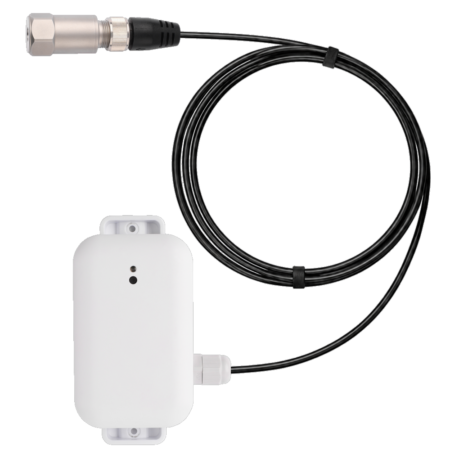
The external vibration probe is separated from the LoRaWAN electronics, allowing it to be installed directly at critical machine measurement points while the wireless electronics enclosure can be positioned in a suitable location nearby.
Application Areas
VibrexIoT is designed for condition monitoring of rotating and reciprocating industrial equipment, including:
- Electric motors.
- Pumps.
- Fans and blowers.
- Gearboxes.
- Bearings.
- Production machinery
- Machine tools.
- Critical rotating equipment.
- Factory automation and Industrial IoT applications.
The sensor is particularly suitable for predictive and preventive maintenance, where vibration trends can be monitored remotely to identify changes in machine behaviour before they develop into more serious failures.
Main Features of the VIBREXIOT
- Industrial piezoelectric vibration probe.
- ±50 g peak acceleration measurement range.
- 1–9,000 Hz frequency response.
- Extended response from 0.5 to 12,000 Hz.
- Acceleration RMS measurement.
- Acceleration Peak measurement.
- Velocity RMS measurement.
- Crest Factor analysis.
- Integrated Health Index (1–5).
- Automatic machine behaviour tracking.
- Probe operating temperature from –40 to +120 °C.
- Shock resistance up to 1,000 g peak.
- Rugged 304 stainless-steel probe.
- Wireless LoRaWAN® communication.
- Battery-powered operation.
These specifications allow the sensor to monitor both general machinery vibration and higher-frequency vibration components while handling strong vibration peaks without easily saturating.
INTELLIGENT MACHINE HEALTH MONITORING
VibrexIoT does more than transmit a single vibration value. The sensor monitors several complementary vibration parameters:
ACC RMS
Indicates the overall level of sustained machine vibration.
ACC Peak
Captures high acceleration peaks and short transient events or impacts.
Velocity RMS
Provides an indication of overall machine vibration severity.
Crest Factor
Compares peak vibration with RMS vibration and can help reveal increasingly impulsive behaviour.
Health Index 1–5
Combines multiple vibration parameters and machine behaviour over time into a simple condition indicator.
For the most reliable condition assessment, measurements should be evaluated as trends over time and compared with a stable machine baseline under similar operating conditions.
Health Index
1 — Normal
Machine operating normally.
2 — Normal
Minor vibration variations detected.
3 — Attention
Increase in vibration level or another abnormal behaviour detected.
4 — Warning
Significant increase in vibration trend.
5 — Critical
High vibration level requiring immediate attention.
The Health Index is intended as a general machine-condition indicator and should be interpreted together with ACC RMS, ACC Peak, Velocity RMS, Crest Factor and historical trends rather than being used as a standalone fault diagnosis.
INDUSTRIAL LORAWAN® CONNECTIVITY
VibrexIoT uses LoRaWAN® Class A communication for low-power wireless
transmission of machine condition data.
The sensor supports:
- LoRaWAN® 1.0.3
- OTAA activation by default
- Optional ABP
- ADR support
- Adaptive channel setup
- End-to-end encryption
- AES-CMAC data-integrity protection
- Multiple regional LoRaWAN frequency plans
Under line-of-sight conditions, communication range can reach up to 10 km, although actual range depends on the installation environment, gateway placement, surrounding structures and network configuration.